Last updated November 17, 2026


Free written scope consultation - allowances, timeline, and change-order rules on paper before a single trade is scheduled
Driveway & Pavers Maintenance Checklist for Lancaster Homeowners
Lancaster’s temperature swings – from 18°F winter lows to 108°F summer highs – put pavers through roughly 90 freeze-thaw and thermal-expansion cycles a year, more than most of coastal California sees in a decade. That math explains why a driveway installed correctly in 2018 can show joint erosion and lippage by 2023 without a single act of negligence. A Lancaster driveway doesn’t fail from neglect in the ordinary sense. It fails from thermal cycling, UV degradation, and alkali soil migration, all following a calendar you can intercept with $80-$200 in annual materials. This guide turns that calendar into a season-by-season, zone-by-zone inspection sequence, with product names, dollar thresholds, and the two visual signs that mean the difference between a $300 DIY fix and a $4,000-$8,000 re-base.
Quick Answer
To maintain a paver driveway in Lancaster, inspect joint sand depth every spring and refill when it drops more than 1/4 inch below the paver surface, check sealant integrity before summer heat spikes, clear drainage channels before winter rain, and treat white efflorescence as a chemistry problem first and a structural warning second. Budget $80-$200 a year for materials. Call a contractor when you see lippage over 1/4 inch or widespread joint sand washout that reappears within two months of refilling – both point to sub-base failure, not surface wear.
Styles & brands we work with
- Kitchen remodeling
- Bathroom remodeling
- Home additions & ADU
- Roofing
- Windows & doors
- Driveway & pavers
- Fence
Table of Contents
- Why Lancaster Pavers Age Faster Than Coastal California Pavers
- Spring Inspection: Joint Sand Depth and What the Straightedge Tells You
- Summer Check: Sealant Integrity Before the 108°F Heat
- Fall Checklist: Drainage Channels and the First Rain Event
- Winter Tasks: Efflorescence, Freeze-Thaw, and Salt Decisions
- Sealant Options for High-UV Desert Exposure
- Alkali Soil Migration: What White Staining Actually Means
- The Two Signs of Sub-Base Failure
Why Lancaster Pavers Age Faster Than Coastal California Pavers
The Antelope Valley sits on some of the most alkali-heavy soil in Southern California, and that chemistry matters as much as the temperature. Soil pH in much of the Lancaster area runs high enough that dissolved salts migrate upward through any moisture pathway in the base layer. When that moisture evaporates at the paver surface – which happens fast at 100°F-plus – the salts crystallize between the pavers and under the surface. This is one half of the “why does my driveway look old” story. The other half is thermal.
A paver expands and contracts with every temperature swing. Lancaster routinely drops from a 95°F afternoon to a 60°F morning in spring and fall, and that daily delta cycles the joints far more than a coastal climate does. Each cycle works the sand in the joint slightly, and each joint that loses sand invites the next paver to shift slightly. Over three to five years, “slightly” becomes visible.
Compare that to a driveway in Long Beach, where the daily swing might be 15°F and the freeze-thaw count is effectively zero. The pavers themselves don’t wear out any faster in Lancaster – a quality Belgard or Techo-Bloc paver is rated for decades. The system around them – sand, sealant, base, drainage – works twice as hard here. Maintaining the system is the whole job.
Spring Inspection: Joint Sand Depth and What the Straightedge Tells You
Spring is the most important inspection window in Lancaster, because you’re seeing the accumulated damage from the freeze-thaw winter on one side and preparing for the heat on the other. The single most useful tool costs about $4: a metal straightedge, or any flat metal bar you already own.
Here’s the sequence we recommend:
- Walk every joint. Lay the straightedge across two adjacent pavers so it bridges the joint. Look at where the sand sits relative to the paver top. Sand should be flush or within 1/8 inch of the surface.
- Flag any joint below 1/4 inch. That’s the DIY threshold. Fill with polymeric sand – Techniseal HP+ runs about $35 a bag and covers roughly 50-75 square feet at joint depth, so a typical two-car Lancaster driveway uses three to five bags.
- Flag widespread loss. If more than 20% of the joints are low, or if you refilled last spring and they’re low again, stop and read the sub-base section below before buying sand.
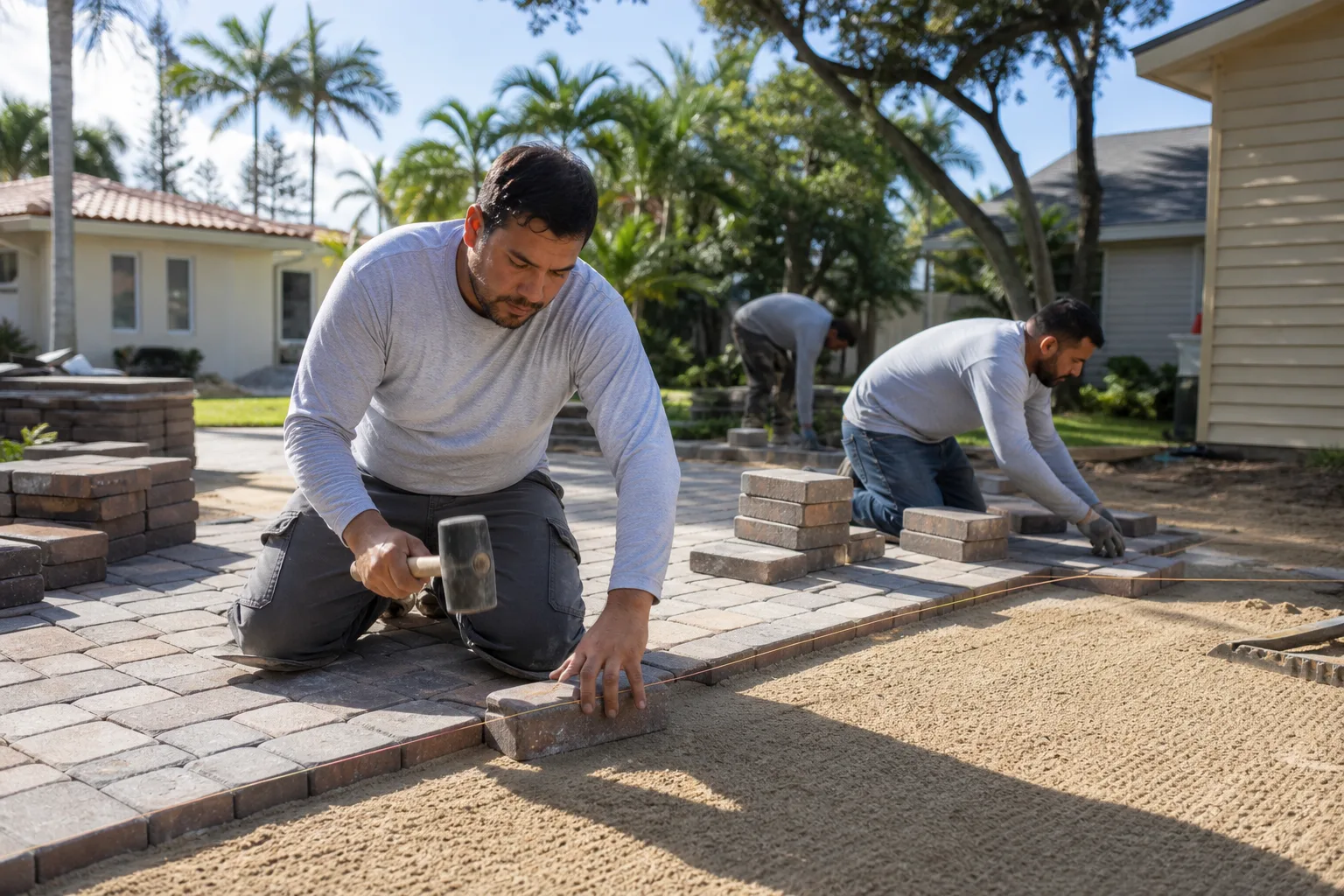
- Check the perimeter. The edge restraint – the plastic or aluminum channel holding the outer row of pavers – takes the worst of thermal expansion. Tap it with a mallet handle. A hollow sound or visible gap means it needs re-securing, and no amount of sand will fix a driveway whose edges are allowed to spread.
Polymeric sand is worth the premium over plain mason sand in Lancaster specifically. Plain sand washes out faster in winter rain and doesn’t resist the joint flex from thermal cycling. The HP+ line activates with water and sets firm – but it must be applied to a dry joint on a dry day, which in Lancaster means late March to early May, before the heat sets in.
Summer Check: Sealant Integrity Before the 108°F Heat
Sealant does two jobs in Lancaster: it slows water intrusion into the base, and it blocks UV from degrading the joint sand and paver color. Both jobs are tested hardest in July and August. The inspection itself is simple.
Pour a cup of water on the driveway in three or four spots. On a properly sealed surface, water beads and sits for a minute or more before soaking in. If water darkens the paver within 15 seconds, the sealant has worn through in that area. Uniform beading across the whole driveway means you have another season. Spotty beading means a spot treatment. Water that soaks in everywhere means a full reseal.
Timing matters. Sealant applied in Lancaster in July cures too fast and can leave a blotchy film – the surface dries before the product levels. The right window is late April through mid-May, when daytime highs are in the 80s and overnight lows stay above 55°F. Fall works too, but it pushes you into the rain season on a surface that needs 24-48 hours of dry cure.
The other summer task is a two-minute check of any expansion joints you have where the driveway meets the garage slab or a sidewalk. Those joints are meant to move. If the filler material has cracked out, replace it with a backer rod and a polyurethane joint sealant – about $12 a tube – before the heat opens the gap further. This one is cheap and prevents a much bigger problem.
Fall Checklist: Drainage Channels and the First Rain Event
Lancaster gets most of its rain between November and March, and a driveway that drains fine in August can pond in January if a channel has filled with grit. Water sitting on pavers does three things: it feeds efflorescence, it softens the base, and it accelerates the freeze-thaw damage when the overnight temperature drops below 32°F after a rain event. That last combination – wet pavers plus a hard freeze – is the single most damaging 24 hours in a Lancaster driveway’s year.
Before the first real rain, walk the fall checklist:
- Clear every drainage channel, channel drain, or swale of grit, leaves, and decomposed granite. A shop vac and a stiff brush get it done in 20 minutes.
- Check that the driveway slopes away from the garage and toward the street or a drain. If you see a low spot in the middle of the field, note it – a persistent low spot after a rain is a base problem.
- Look at the soil on the downslope side of the driveway. Erosion there means water is exiting where it shouldn’t, and the edge restraint is at risk.
- Walk the driveway after the first hard rain and photograph any ponding. Photographs make the conversation with a contractor ten times more useful.
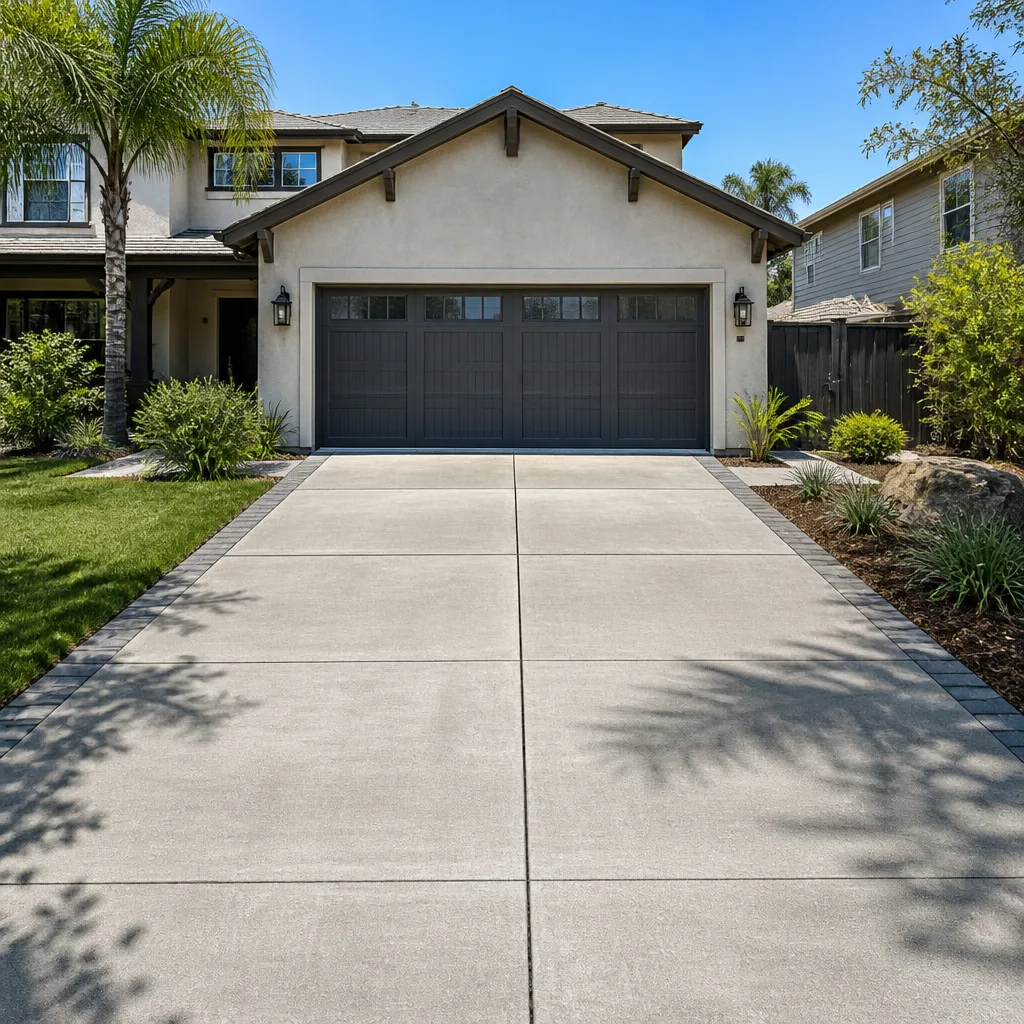
If you want to learn how a properly built driveway handles drainage from the base up – because the design differs from a plain concrete pour – our Driveway & Pavers in Lancaster page walks through the base preparation and grading that drive the outcome. And if a drainage swale runs along your property line, keep it clear; the same water that threatens your pavers can undermine a fence post, which is one reason a properly set Fence Installation in Lancaster includes drainage consideration.
Winter Tasks: Efflorescence, Freeze-Thaw, and Salt Decisions
Lancaster winters are mild by national standards but hard on pavers, because the freeze-thaw cycle is the whole problem and it happens dozens of times. Overnight lows in the teens and twenties are routine in January, and daytime recovery into the 50s and 60s means every single one of those cycles works the joints. There’s not much to do in winter except avoid making it worse.
The salt question comes up every year. Rock salt and calcium chloride de-icers are the standard in colder climates, but on pavers they accelerate surface scaling and can stain. In Lancaster, most winters don’t require de-icer at all – a stiff broom and a little patience handle snow. If you must treat ice, use sand for traction. It’s cheap, it’s non-damaging, and it sweeps away. If ice forms in a persistent shaded spot, treat it as a drainage symptom and fix the drainage rather than the ice.
Winter is also when efflorescence shows up most visibly, because moisture is moving through the pavers. Don’t panic and don’t start scrubbing with acid. Read the alkalinity section below before you touch it, because the wrong treatment can etch the paver face permanently.
Sealant Options for High-UV Desert Exposure
There are two families of paver sealant, and picking the wrong one for Lancaster is a common and expensive mistake. Here’s the comparison a homeowner can actually use:
- Penetrating silane-siloxane sealers. These soak into the paver and react with the surface to repel water without leaving a film. They don’t change the appearance, they don’t peel, and they’re vapor-permeable, which means moisture inside the paver can escape. Reapplication is every 3-5 years in a high-UV climate like Lancaster. A typical two-car driveway costs $150-$250 in product for the DIY route.
- Film-forming acrylic sealers. These sit on top and leave a visible sheen, sometimes with a wet look. They offer strong UV blocking and a clean appearance for the first two seasons. But in Lancaster, UV and heat degrade acrylic film faster than in cooler climates – reapplication every 1-3 years – and once the film begins to fail it can flake, and flaked film looks worse than an unsealed driveway. Film sealers also trap moisture if the base isn’t fully dry before application, which is why they’re riskier on a driveway with any drainage issue.
For most Lancaster driveways on a maintenance schedule that suits a homeowner rather than a contractor, penetrating silane-siloxane is the safer choice. It’s more forgiving of application timing, it doesn’t peel, and the reapplication interval – 3-5 years – lines up with the durable nature of quality pavers. Film sealers make sense for a driveway that’s already been sealed with one (you can’t switch without stripping the old film) or for a homeowner who wants a specific wet-look finish and is prepared to maintain it every two years.
Alkali Soil Migration: What White Staining Actually Means
Efflorescence – the white, powdery staining that appears on paver faces and joints – is common in Lancaster and often misdiagnosed. It is not mold, it is not a defect in the pavers, and it is not always a sign of failure. It’s chemistry. Water carrying dissolved salts from the soil and the base migrates upward through the paver, reaches the surface, evaporates, and leaves the salts behind as a crystal deposit.
The chemistry matters because it determines the treatment. The white deposit is water-soluble in its fresh state. A dry brush and a light rinse often remove it. If it comes back repeatedly in the same area, the salts are still being fed from below, which means moisture is still moving – and that points at drainage or base moisture, not at the surface.
Do not acid-wash fresh efflorescence on pavers. Muriatic acid can etch the paver face and the joint sand permanently, and it doesn’t solve the underlying moisture feed. If efflorescence keeps returning across two seasons, the question becomes whether the driveway’s base has a moisture route that water is exploiting. That’s a professional diagnosis, not a DIY one. A driven visual inspection of the base and grading at the edges usually answers it in under an hour.
As for whether it’s cosmetic or structural: fresh, removable efflorescence on pavers that are otherwise stable is cosmetic. Efflorescence accompanied by visible lippage, softened joints, or a persistent low spot is a symptom of the underlying problem covered next.
The Two Signs of Sub-Base Failure
Surface wear is recoverable with $80-$200 of annual maintenance. Sub-base failure is not – and it’s the difference between a DIY repair and a professional re-base at $4,000-$8,000 for a typical Lancaster driveway. You need two visual signs to know which one you’re looking at, and the difference is clear once you know what to check.
Sign one: lippage over 1/4 inch. Set your straightedge across two pavers that share a joint. If one paver stands taller than its neighbor by more than 1/4 inch – beyond the normal tolerance – the base under that paver has settled. Small isolated lippage can sometimes be traced to one paver or one localized pocket. Widespread lippage across a section means the base beneath the whole section has moved.
Sign two: joint sand that won’t stay put. If you refilled the joints with polymeric sand in spring and by summer more than 20% of them are low again, the sand is falling into a void. The joint isn’t “losing” sand to the wind. It’s draining into a base that has shifted, and the sand is the visible symptom.
Either sign on its own is worth a professional look. Both together, in the same section of driveway, is a strong indicator that re-basing is the honest repair rather than another round of sand and sealant. Photo documenting both signs – straightedge in place, close-up of the low joints – is exactly the kind of record a good contractor’s inspection produces, and it’s worth doing yourself before you call anyone. Our Rowan Construction Group Lancaster home page describes how we document conditions like these on every visit, and the same photo record is standard on a driveway inspection.
Common Mistakes to Avoid
- Power-washing joints at full pressure. The same high-pressure water that strips dirt also blows the joint sand out – so you pay for a refill you didn’t need. Use a fan tip at low pressure, or a garden hose and a stiff brush.
- Applying polymeric sand to a wet joint or on a windy day. The activating water has to soak in without washing the sand away. In Lancaster, the afternoon winds pick up most days by 2 p.m.; apply in the morning and let the sand settle before the wind does.
- Sealing over efflorescence. Sealing traps the salt crystals under the film, and the film lifts within a season. Clean and confirm the efflorescence has stopped returning before you seal.
- Treating efflorescence with acid. Muriatic acid etches paver faces and joint sand. Brush it dry, rinse lightly, and if it keeps coming back, diagnose the moisture source.
- De-icing with rock salt. Lancaster winters almost never justify it. If you must treat ice, use sand – salt accelerates surface scaling and stains.
- Ignoring the edge restraint. The perimeter is where thermal expansion goes to work. A loose edge on a Lancaster driveway is the beginning of a spreading driveway.
- Refilling sand without asking why it vanished. If the joints lose sand every spring, that’s the base asking for attention, not the sand supply.
See the difference
 Before
 After
 Before
 After
 Before
 After
When to Call a Professional
Call a professional when any of the following are true: lippage exceeds 1/4 inch across a section of driveway; refilled joints lose their sand within a season; a persistent low spot holds water hours after rain ends; edge restraint is loose or the driveway is spreading at the perimeter; or efflorescence returns across two consecutive seasons in the same spot. Any of those points at the base rather than the surface, and that’s a $4,000-$8,000 repair in Lancaster, not a sand-and-seal weekend. The good news: a driveway still in the maintenance phase is cheap to keep that way.
Rowan Construction Group Lancaster offers free estimates in Lancaster – call (844) 797-3312. Every estimate is a written price with a written scope before any work starts, backed by our 365-Day Done Right Promise. If you already have a written quote from another contractor, we’ll review it line by line as a free second opinion, and if you’re planning a larger project, our Home Additions & ADU in Lancaster page covers how a new structure interacts with driveways and hardscape.
Frequently Asked Questions
Annual DIY maintenance runs $80-$200 in materials for a typical two-car driveway – polymeric sand (Techniseal HP+ at about $35 a bag), joint sealant, and a sealing product every three to five years. Professional resealing of a two-car driveway generally runs $400-$900 depending on size and product. Call (844) 797-3312 for a written estimate on your specific driveway; estimates are free.
Check depth every spring and refill when sand sits more than 1/4 inch below the paver surface. A well-built driveway with a proper base and good polymeric sand may only need a partial refill every two to three years. If you’re refilling the same joints every year, the base beneath them is the real problem – call us at (844) 797-3312 for an inspection.
Yes, mild white staining is common and usually cosmetic in Lancaster, where alkali soil and dry weather combine to produce efflorescence on a lot of driveways. It’s dissolved salt left on the surface after moisture evaporates. Brush it dry and rinse. If it returns repeatedly in the same area across more than two seasons, the moisture feed underneath needs a professional look – call (844) 797-3312 for a free estimate.
Yes, with a penetrating silane-siloxane sealer rather than a film-forming acrylic. High UV in Lancaster degrades acrylic films in one to three years, and a peeling film looks worse than an unsealed driveway. Penetrating sealers reapply every three to five years and are more forgiving of the hot-weather application window. We’ll tell you honestly which your driveway needs in a free written estimate – (844) 797-3312.
The pavers themselves last decades – quality Belgard or Techo-Bloc pavers are rated for 30 years or more. The base, sand, and sealant system is what ages. With annual maintenance in the $80-$200 range and timely resealing, most Lancaster paver driveways stay stable well past 20 years. Without maintenance, base problems that would have been a $300 repair become a $4,000-$8,000 re-base. Call (844) 797-3312 to schedule a free inspection.
Often, yes – one or two settled pavers can be lifted and reset with fresh base material without disturbing the rest, provided the surrounding field is stable. Our technicians have up to 19 years of experience reading which failures are isolated and which are systemic. If it’s isolated, we’ll reset it. If it’s not, we’ll show you the photos and tell you the honest scope. Call (844) 797-3312 for a free estimate.
The Bottom Line
Lancaster paver driveways don’t fail from neglect. They fail from a predictable calendar of thermal cycling, UV, and alkali migration that a homeowner can intercept for under $200 a year – and the whole checklist fits into two weekends, one in spring and one in fall. Check joint sand depth with a straightedge every spring. Confirm sealant beading before the summer heat. Clear drainage before the first winter rain. Treat white efflorescence as a chemistry question, not a panic. And when lippage passes 1/4 inch or sand refuses to stay in the joints, stop buying sand and get the base inspected. That one decision – knowing which phase your driveway is in – is what keeps a driveway a driveway instead of a $6,000 repair.
Rowan Construction Group Lancaster quotes driveway and hardscape work with a flat written price and written scope before any work starts, under No-Hassle Upfront Pricing, and backs it with the 365-Day Done Right Promise. Every visit includes a documented photo record as standard – not an upgrade – and the crews are background-checked and uniformed, with a live person answering calls 24/7. If you’re also thinking about the structures around your driveway, windows, doors, roofing, and additions all live under the same standard, and you can start with a free estimate from Rowan Construction Group Lancaster. Call (844) 797-3312 today and we’ll put the number in writing before anyone picks up a tool.
Written by the team at Rowan Construction Group Lancaster.