Last updated November 17, 2026
Free written scope consultation - allowances, timeline, and change-order rules on paper before a single trade is scheduled
Driveway & Pavers Maintenance Schedule: What to Do and When
Lancaster homeowners are told to “seal their pavers every few years.” That interval is too slow for the high desert’s UV load and too fast for some paver types. The right schedule depends on the paver material and the sealer chemistry, and running the wrong cycle costs more than doing nothing at all. A paver driveway kept on a proper Lancaster calendar lasts 25 to 40 years. The same driveway left to a vague “check it now and then” habit usually needs major work inside 10. This guide gives you specific months, specific tasks, and the products that actually hold up here.
Quick Answer
In Lancaster, a paver driveway needs four scheduled touchpoints a year: a post-winter inspection in February, a pre-summer sealer assessment in April, a monsoon-season drainage and joint check in August, and a joint sand top-off in October. Deep cleaning and resealing happen every 3 to 5 years for penetrating sealers and every 1 to 2 years for film-forming sealers, not on a fixed “every few years” clock. Everything else is inspection and small fixes.
Styles & brands we work with
- Kitchen remodeling
- Bathroom remodeling
- Home additions & ADU
- Roofing
- Windows & doors
- Driveway & pavers
- Fence
Table of Contents
- Why Lancaster’s Climate Punishes a Vague Maintenance Schedule
- The Month-by-Month Paver Calendar for Lancaster
- The Water-Bead Test: How to Know If Your Sealer Is Still Working
- Which Polymeric Sand Holds Up Under Lancaster’s UV and Heat
- Penetrating vs. Film-Forming Sealer: What Goes on Which Paver
- Drainage, Slope, and Base: The August Check That Prevents Winter Failure
- The One-Page Maintenance Log (Three Fields, That’s It)
- Common Mistakes to Avoid
Why Lancaster’s Climate Punishes a Vague Maintenance Schedule
Lancaster sits at roughly 2,300 feet in the Antelope Valley, and that elevation changes how pavers age. Summer surface temperatures on exposed pavers in the west valley routinely run 40 to 60 degrees hotter than the air. Winter brings hard overnight freezes in December and January, sometimes in the teens. Spring wind carries fine desert grit that works into joints like abrasive paste. Then the late-summer monsoon arrives and drops a month of rain in an afternoon.
Each of those conditions attacks a different part of the system. UV degrades sealer and polymeric sand. Freeze-thaw cycles open joints and lift edges where water has pooled. Wind loads joints with grit that grinds sand loose from the inside. Monsoon rain finds every low spot and every failed joint and pushes base material out from under the pavers. A schedule that only thinks about “sealing” ignores three of the four threats.
We’ve seen the pattern in every part of the valley. In Quartz Hill, driveways on the open west-facing lots fade and lose joint sand faster than anywhere else because there’s no afternoon shade. In older eastside Lancaster neighborhoods, the problem is often the opposite: pavers installed over a base that was never compacted to spec, so no amount of sealer fixes the settling. And in the newer tracts off Avenue K and the west side, we regularly see spring failures in driveways less than five years old, because a film-forming sealer was applied too thick and trapped moisture underneath.
The point is simple. The calendar below isn’t cosmetic maintenance. It’s what keeps a paver system’s four working parts, the base, the bedding layer, the joint sand, and the surface, doing their jobs through a climate that stresses all four.
The Month-by-Month Paver Calendar for Lancaster
Here’s the schedule we hand to Lancaster homeowners at project closeout. Four fixed touchpoints, plus one recurring task that follows its own clock.
- February: post-winter inspection. Walk the entire driveway after the last hard freeze. Look for lifted, rocking, or sunken pavers, joint sand washed out at the edges, and any new crack in the sealer film. Mark problem pavers with chalk so you can find them again. This is the single most important inspection of the year in Lancaster, because freeze-thaw damage is easiest and cheapest to fix before the spring winds spread it.
- April: pre-summer sealer assessment. Before the heat arrives, run the water-bead test (below) on three or four spots. If the sealer has failed, it needs to be recoated before June, not after. Applying sealer in 100-degree heat causes it to flash and cure unevenly. April and early May are the window.
- August: monsoon drainage check. Before or during the late-summer rain window, walk the driveway during a storm or just after. Watch where water pools, where it runs off the edges, and where it disappears. Any spot holding water more than a few hours needs its slope or drainage corrected. A paver driveway that drains well in August won’t fail in February.
- October: joint sand top-off. After the summer, joints are typically down 1/8 to 1/4 inch. Top them off with the correct polymeric sand for your paver type before the freeze season. Missing joint sand is the number one cause of paver loosening, because the sand is what locks the pavers to each other.
- Every 3 to 5 years (penetrating sealer) or 1 to 2 years (film-forming sealer): deep clean and reseal. This is the only task on a multi-year clock, and the interval depends entirely on sealer chemistry, which we cover below. Don’t default to “every few years” for everything.
That’s the whole calendar. For a Lancaster driveway of average size, the four fixed touchpoints total maybe 4 to 6 hours of homeowner time across the year, plus the cost of a bag or two of joint sand and a sealer recoat when needed. Compare that to the $6,000 to $14,000 a full paver driveway replacement runs in this market, and the math is not close.
The Water-Bead Test: How to Know If Your Sealer Is Still Working
The water-bead test is the most useful five-second diagnostic in paver maintenance, and almost nobody does it. Here’s how it works.
- Pick three spots on the driveway: a heavy-traffic area (usually near the garage), a low spot, and an edge. Test all three because sealer wears unevenly.
- Drip a small amount of water from a cup or bottle onto each spot and watch for 30 seconds.
- Pass: the water beads up into droplets and sits on the surface, or runs off without soaking in. The sealer is intact.
- Marginal: the water darkens the paver surface slowly or spreads out flat without absorbing. The sealer is thinning and will fail within a season.
- Fail: the water darkens the paver almost immediately and soaks in within a few seconds. The sealer is gone and the pavers are unprotected.
What does a failed sealer look like before you test it? On a penetrating sealer, look for a dull, chalky, uniform gray where the surface used to have depth and color. On a film-forming sealer, you’ll see it first: cloudy white patches, peeling edges, or a crazed, cracked film like dried mud. That white haze is trapped moisture under a film that can no longer breathe, and it’s the signature of a sealer that was applied too thick or recoated too soon.
If your Lancaster driveway is showing the white-haze failure, don’t just apply another coat on top. The old film has to be stripped first, and that’s a job worth handing off. Call us at (844) 797-3312 for a free estimate if you’re not sure what you’re looking at.
Which Polymeric Sand Holds Up Under Lancaster’s UV and Heat
Not all polymeric sand is built for the high desert, and the wrong choice costs you a joint top-off every single year. Here’s the honest rundown of what we install and why.
- Techniseal (we use their polymeric and their jointing sand lines). Their formula is among the most UV-stable we’ve installed in Lancaster’s heat, and it holds up through the freeze-thaw cycle better than cheaper blends. Their color-matched options make a top-off blend in well.
- Alliance Gator (Gator Maxx and similar). Very reliable under UV, and it cures hard enough that wind-driven grit doesn’t erode it as fast as weaker blends. Good for the west valley where afternoon sun is relentless.
- DOMINATOR. A strong performer in high-heat installations, with good resistance to joint erosion. We’ve had good results on driveways in the Quartz Hill and west Lancaster areas.
- Generic or bargain polymeric sand. Here’s the problem. Many cheap blends use binders that break down under sustained UV and heat, so you end up with a joint that turns to sand again within 12 to 18 months. That’s the annual-replacement treadmill, and it’s more expensive over five years than buying the good product once.
Two other factors matter more than the brand. First, polymeric sand only works if it’s installed dry, activated with a proper light misting, and not over-watered, which is why a failed top-off often comes down to technique rather than product. Second, on Lancaster driveways, the joints need to be deep enough (generally 1/4 inch below the paver surface minimum) for the sand to lock. If your joints are shallow, no sand will last. If you’re weighing a joint fix against a full replacement, our Driveway & Pavers in Lancaster page covers what a proper installation looks like.
Penetrating vs. Film-Forming Sealer: What Goes on Which Paver
This is where most Lancaster homeowners get the schedule wrong, because the sealer type sets the reseal interval. Two chemically different products, two different clocks, and the wrong one on the wrong paver is a failure waiting to happen.
- Penetrating sealers soak into the paver and protect from the inside. They don’t change the surface appearance (or only slightly, adding depth). They need recoating every 3 to 5 years in Lancaster, sometimes 2 to 3 on the most sun-exposed lots in Quartz Hill. Approximate cost: $1.50 to $3.50 per square foot installed, or a fraction of that if you apply it yourself. Best for concrete pavers and most natural stone.
- Film-forming sealers sit on the surface and create a visible layer, often with a wet-look gloss. They’re the ones that haze, peel, and trap moisture. In Lancaster’s heat they need recoating every 1 to 2 years, and some products don’t survive a summer without degrading. Approximate cost: $2 to $4 per square foot installed. They’re appropriate only on certain paver types and only when applied thin and correctly, and honestly, on a high-desert driveway, most of the time they aren’t worth the maintenance.
Which sealers do we actually spec by name? On the penetrating side, products from the Techniseal and DOMINATOR lines, chosen to match the paver material. On the film side, when a homeowner wants the wet look and understands the recoat schedule, a quality acrylic that’s rated for high-UV exposure.
If you’re deciding between pavers and concrete right now, you’re weighing more than sealer. Our guide on Fence Installation in Lancaster speaks to the same “cheap upfront, expensive later” math, and it’s why we always name the product on the written quote rather than specifying “sealer” generically.
Drainage, Slope, and Base: The August Check That Prevents Winter Failure
Almost every paver failure we see in Lancaster traces back to drainage. Water is the enemy of every paver system, and the high desert is deceptive about this, because it’s dry 11 months a year and then delivers a season of rain in a month.
Do the August check with a hose and a trained eye, or call us for a free second opinion if you already have a written estimate from another contractor. Here’s what to watch for:
- Pooling. Any spot where water stands more than a couple of hours after a storm has a slope or base problem. On a well-installed driveway, water should sheet off within minutes.
- Slope at the edges. The driveway should pitch away from the garage and foundation. If water runs toward the house, that’s a repair, not a cleaning.
- Base erosion. If a paver rocks, feels hollow when you step on it, or sits noticeably lower than its neighbors, the bedding layer underneath has washed out. That’s a base problem masked as a surface problem, and no sealer or sand will fix it.
- Settlement near pipes and utilities. Any penetration through the paver field, a utility cover, a downspout outlet, tends to be the first place settlement shows up. Check those spots specifically.
- Drain inlets on the edge. Make sure they’re clear before August. A clogged channel drain turns a functioning driveway into a pond in one storm.
If settlement is severe, the fix isn’t a maintenance task, it’s a sub-base rebuild. That’s the point in the calendar where a professional inspection saves you money, because catching a base problem in year three beats replacing a driveway in year ten. If you’re already thinking about a larger project, an Home Additions & ADU in Lancaster build is where drainage design gets the most scrutiny, and the same principles apply to a driveway.
The One-Page Maintenance Log (Three Fields, That’s It)
Every Lancaster driveway we hand off comes with a maintenance log, and it’s the single habit that makes the calendar stick. It’s one page, three fields, one line per task. That’s the whole system.
- Date. The month and day the task was done. Nothing fancy, a paper calendar works.
- Task. What you actually did: “top-off joints, spring inspection, sealer water-bead test.” Be specific enough that a stranger could read it.
- Product and quantity. What brand and how much: “one bag Techniseal polymeric, one quart penetrating sealer.” This is the field people skip, and it’s the one that matters most, because knowing exactly what sealer went down is how you avoid putting a film-forming product over a penetrating one, which is a guaranteed failure.
That log does three things. It tells you precisely when your next reseal is due, based on the product’s interval rather than a vague memory. It tells a future buyer or contractor what’s under the surface. And it catches the pattern of recurring failures, like the same joint washing out every month, which usually points to a drainage issue you’d otherwise keep patching.
It’s the same documentation discipline we apply to every Rowan project. Under the Haven Standard, every visit includes a documented photo record as a standard deliverable, and under Clause 1, the flat written price goes down before anyone picks up a tool. That’s the basis of our 365-Day Done Right Promise. You can see the same approach across the Rowan Construction Group Lancaster home page. A maintenance log is the homeowner’s version of the same idea.
Common Mistakes to Avoid
- Sealing on a fixed “every few years” clock. The interval depends on the sealer chemistry, not the calendar. Film-forming sealers need recoating every 1 to 2 years in Lancaster; penetrating ones every 3 to 5. Using the wrong interval either wastes money or voids the protection.
- Applying sealer over a failing film. Another coat over a hazed, peeling film traps moisture and makes it worse. Strip the old film first, every time.
- Skipping the October sand top-off because “it looks fine.” Joint sand settles invisibly, and the gap is where water gets in before the freeze. A five-minute top-off in October prevents a settle-in-place repair in February.
- Using bargain polymeric sand. Cheap sand under Lancaster’s UV breaks down in 12 to 18 months. The annual replacement treadmill costs more than buying a UV-stable product like Techniseal, Gator, or DOMINATOR once.
- Pressure-washing at full blast. A high-pressure washer strips sealer and blasts joint sand out of the joints. Use low pressure, a wide nozzle, and a proper paver cleaner.
- Ignoring a rocking paver. A single loose paver is the earliest sign of base erosion. Fix it early and it stays a $50 to $150 repair. Ignore it and it becomes a full base rebuild.
- Testing the sealer with a visual glance instead of water. A paver can look fine and have no protection left. The water-bead test takes five seconds and tells you the truth.
See the difference
 Before
 After
 Before
 After
 Before
 After
When to Call a Professional
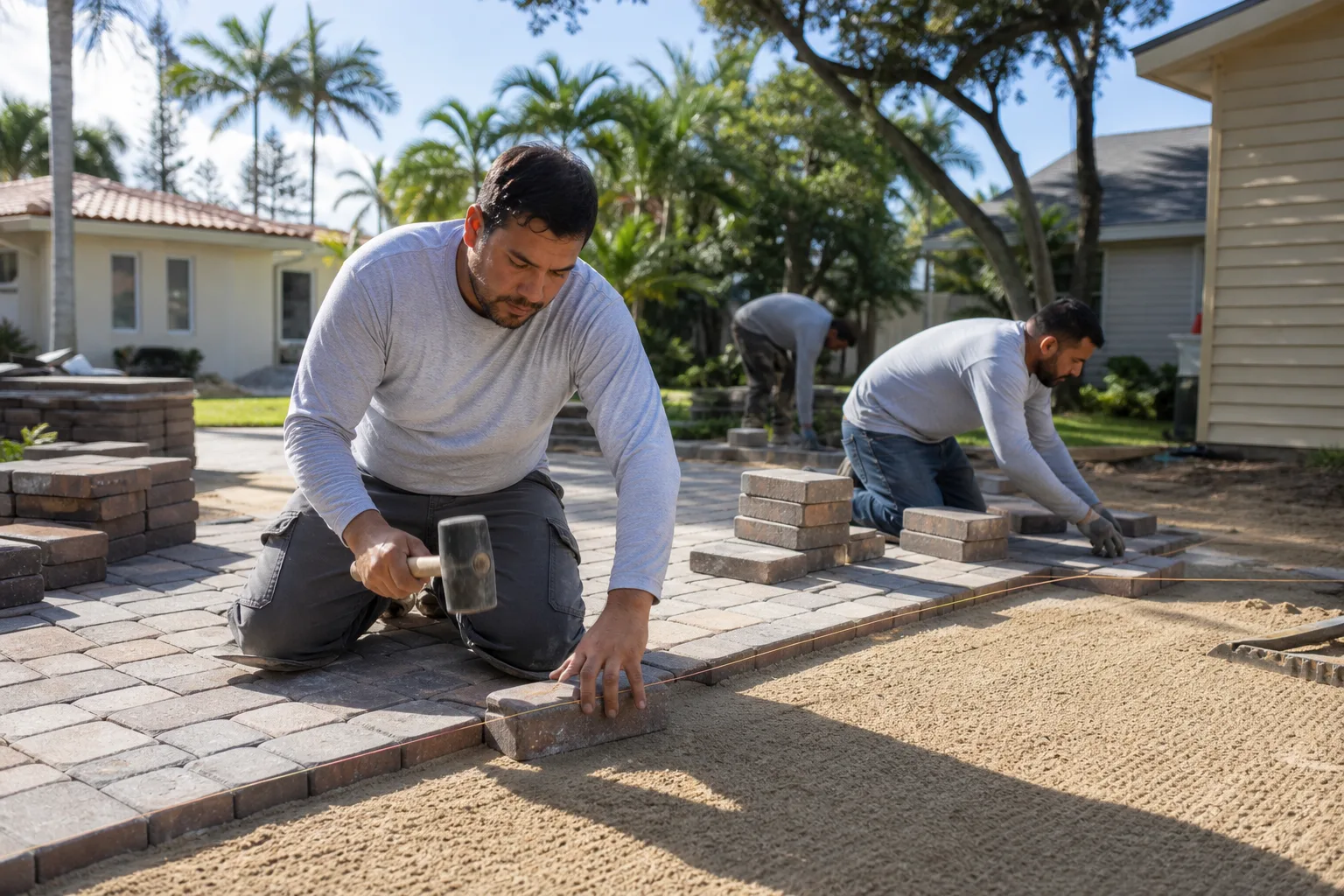
Some paver problems are honest homeowner maintenance. Others need a trained eye and a documented scope. Call a professional when you have any of the following: rocking or sunken pavers anywhere on the driveway; a failed film-forming sealer that needs stripping before recoating; standing water more than a few hours after a storm; a joint that washes out repeatedly in the same spot; or a failing paver system you’re considering repairing versus replacing. Structural repair on top of a bad base is where DIY efforts go wrong most often, and the base is what you can’t see from the surface.
Our technicians have up to 19 years of experience with paver systems and site work across the Antelope Valley, and we’re state-licensed and insured. Rowan Construction Group Lancaster offers free estimates in Lancaster, and if you already have a written estimate from another contractor, we’ll give you a free second opinion, line by line, at no charge. Call (844) 797-3312.
Frequently Asked Questions
Penetrating sealers need recoating every 3 to 5 years in Lancaster, and film-forming sealers every 1 to 2 years because the heat and UV degrade the surface film faster. The interval depends on the sealer chemistry, not a fixed schedule. Call (844) 797-3312 for a free estimate on a sealer assessment and written price before any work starts.
Most homeowners can handle a joint sand top-off and the water-bead test themselves, but seal application and any base repair are worth handing off. A failed film-forming sealer has to be stripped before recoating, and that wrong step causes most of the paver failures we see. When in doubt, call us for a free second opinion on any written estimate.
Yes, and it’s the single most underestimated risk on a Lancaster driveway. The late-summer rain finds every failed joint and low spot, pushes base material out, and sets up a freeze-related failure the following winter. The August drainage check is what prevents that sequence. Call (844) 797-3312 to schedule a free estimate if your driveway is showing standing water.
Annual maintenance, cleaning, joint sand, and inspection, typically runs $150 to $400 a year for an average Lancaster driveway. A reseal on a 400-to-600 square foot driveway runs roughly $900 to $2,000 depending on sealer type. A full paver replacement runs $6,000 to $14,000. The maintenance math wins every time. Call (844) 797-3312 for an exact quote, estimates are free.
April and early May are the window in Lancaster, before the heat arrives and after the last freeze. Applying sealer in 100-degree temperatures causes it to flash and cure unevenly, and applying it before a hard freeze traps moisture. The April pre-summer assessment tells you whether you need to reseal that year at all. Call (844) 797-3312 to schedule the assessment.
A paver driveway on a proper maintenance calendar lasts 25 to 40 years in Lancaster’s climate. The same driveway left to a vague “check it now and then” schedule typically needs major work inside 10 years, because the base fails long before the pavers wear out. The calendar in this guide is what closes that gap. Call (844) 797-3312 for a written estimate on any repair or replacement.
The Bottom Line

A Lancaster paver driveway lives or dies on its calendar, and the calendar is four touchpoints a year: February inspection, April sealer assessment, August drainage check, October joint sand top-off. Deep cleaning and resealing follow the sealer chemistry, every 3 to 5 years for penetrating, every 1 to 2 years for film-forming. Test with water, not with your eyes. Use UV-stable polymeric sand like Techniseal, Gator, or DOMINATOR, and log what you applied and when. Do the four touchpoints and you’ll get 25 to 40 years. Skip them and you’ll be replacing the driveway inside a decade. That’s the whole schedule, and it’s worth keeping on the fridge.
When you’re ready to price a repair, a reseal, or a full replacement, call Rowan Construction Group Lancaster at (844) 797-3312 for a free estimate. You’ll get a flat written price and a written scope before any work starts, a documented photo record on every visit, and our 365-Day Done Right Promise behind the work. That’s the same discipline the schedule in this guide is built to protect.
Written by the team at Rowan Construction Group Lancaster.