
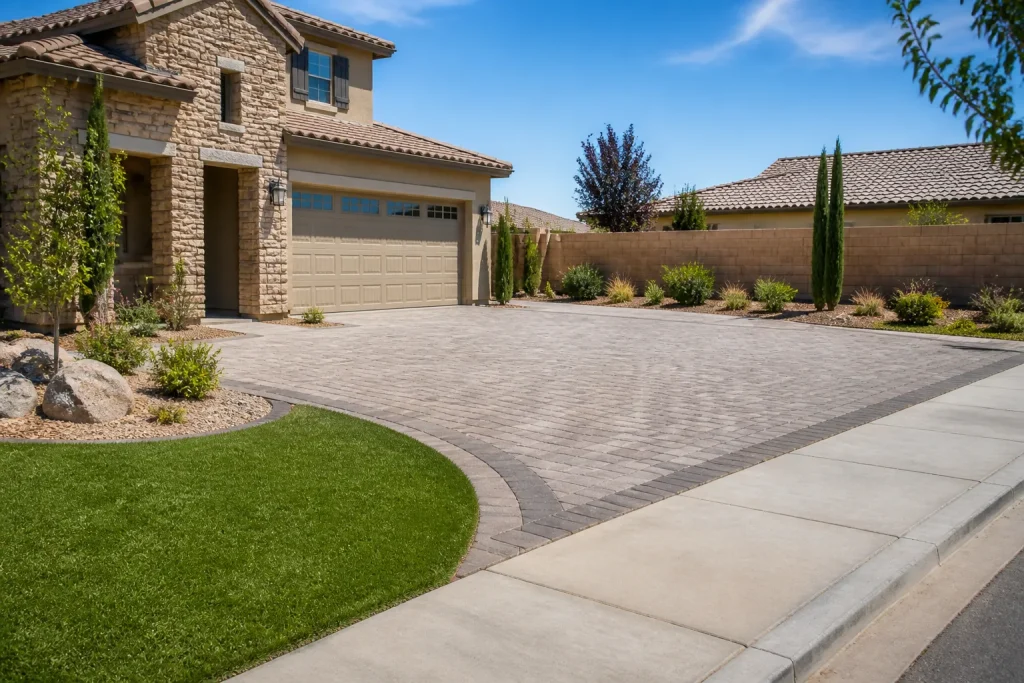
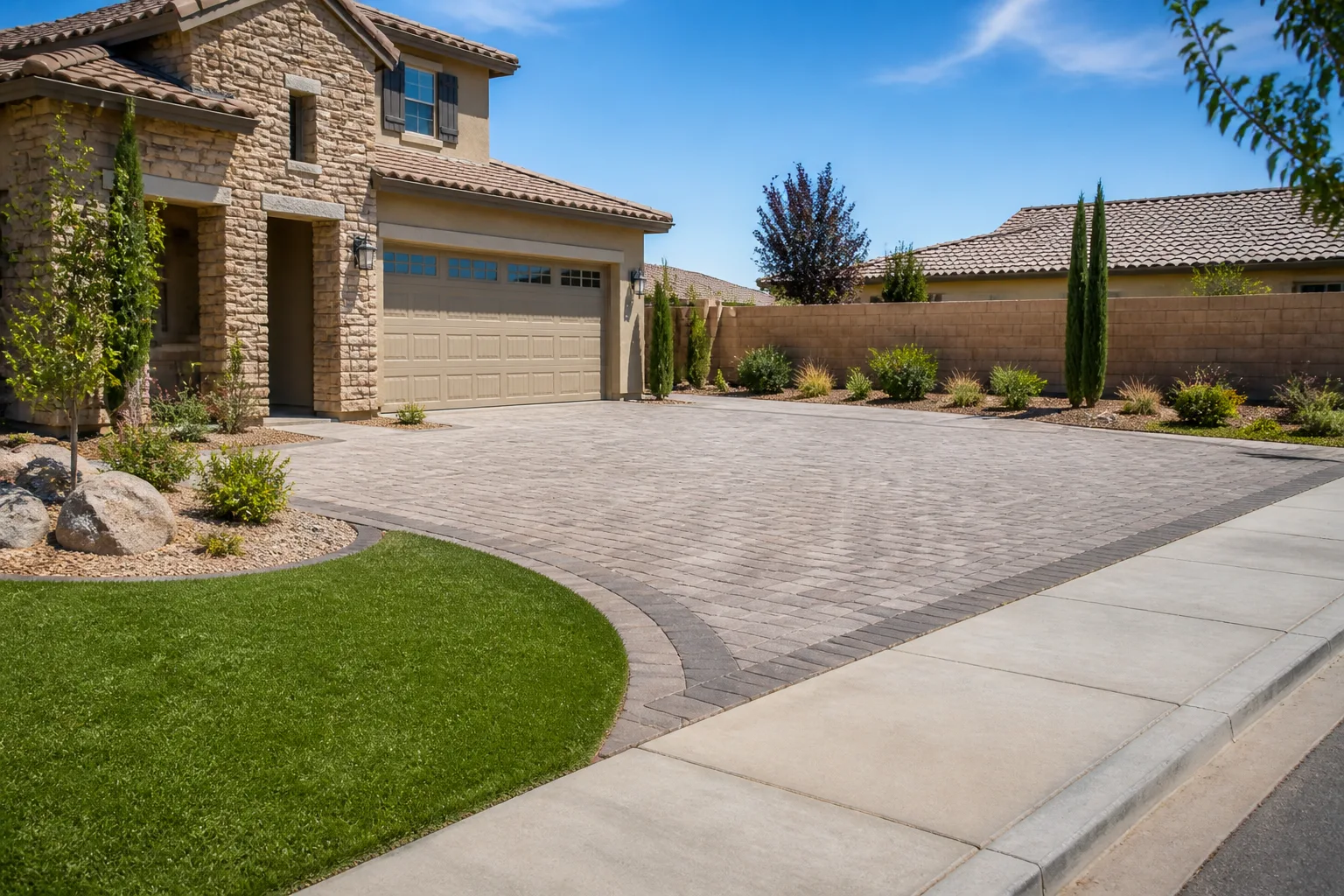
Delta Driveway & Pavers in Lancaster: A Homeowner’s Guide
Delta’s interlocking paver system calls for a base surface tolerance of plus or minus 3/8 inch across a 10-foot straightedge. On paper that looks reasonable. In practice, it’s a number a lot of general paver crews can’t hit with the equipment they bring to a Lancaster driveway. When the base misses that window, the pavers still go down and still look fine the day the job wraps. Then the second summer arrives, the units start rocking, and the joints open up at the corners. The failure was set on day one, in the base.
If you’re pricing Delta for your own driveway and would rather have a contractor who reads the manual than one who learned on standard pavers, call us at (844) 797-3312 for a free estimate. If you want to go deeper first, the rest of this guide is what to check before the first unit goes down.
What makes Delta’s interlocking geometry different from standard pavers?
Standard face-lay pavers are essentially rectangular blocks set in sand with butt joints, where units sit edge to edge and the joint gap is the sand line between them. Delta’s interlocking system is different: each unit has a shaped edge profile that keys into the adjacent unit, and that keyed geometry is what carries vehicle load across the surface rather than down through a single paver to the base. That is the whole point of the system, and it’s also why the installation tolerance is tighter.
An interlocking unit only does its job if the paver beside it sits at the exact same elevation and on the exact same plane. A hair of rock in one corner and the key no longer seats. The load path breaks and you get a high corner, a low corner, and a joint that will open with the first hard freeze-thaw or the first real summer heat cycle. Standard pavers can tolerate a little more base irregularity because the load is transferred through the sand bed and the paver body. Delta’s geometry doesn’t have that slack.
Practically, that means the crew needs a screed rail setup, either a rail system on the sand bed or a laser-guided screed, to establish a dead-flat plane before setting any units. Most paver crews in Lancaster carry a screed rail on the truck. A surprising number of general contractors working out of a pickup don’t. Ask which one shows up for your estimate.
What base flatness does Delta specify, and how do you verify a contractor can hit it?
The Delta technical manual specifies base surface tolerance of plus or minus 3/8 inch over a 10-foot straightedge. That means if you put a 10-foot straightedge on the prepared base, the surface under it should never be more than 3/8 inch higher or lower than the straightedge line at any point. It’s a flatness call, not a slope call. The base still needs the appropriate fall for drainage, but the plane has to be true.
Verifying that a contractor can actually achieve it comes down to a few things worth asking at the estimate, before any paperwork is signed:
- Compaction equipment. Ask about the plate compactor and how many passes they run. Delta’s tolerance assumes a properly compacted Class II base, and proper compaction is what holds that flat plane after the pavers go down.
- Screed method. A screed rail on the sand bed is the standard approach. Ask the crew to describe their setup.
- Straightedge check. A contractor who takes flatness seriously will have a 10-foot straightedge on site and walk the base with it before setting pavers. Ask whether that step is on their site checklist.
- Moisture and time underfoot. A base that’s been walked on by the whole crew and their wheelbarrow for two days can lose its plane. Ask how they protect the base once it’s set.
Lancaster’s soil is largely decomposed granite and sandy loam, which drains fast and compacts predictably, one of the reasons this area is easier to base-prep than, say, the clay-heavy neighborhoods across the San Gabriel Valley. But the same dry climate means the base can lose moisture quickly on a hot afternoon, and sand that’s too dry won’t hold a screeded plane. Local crews who work here regularly know to keep the bed moist enough to screed clean.
Which Delta patterns hold up best under vehicle load in Lancaster?
Delta’s pattern selection matters more than most homeowners realize. The pattern determines how each paver’s edge keys into its neighbors, and that keyed geometry is what transfers tire loads across the running surface. Three patterns show up most on Lancaster driveways, and they behave differently.
- Herringbone (45-degree or 90-degree). The most load-resistant pattern in Delta’s lineup. Every unit is locked on two sides, and the alternating orientation means a tire rolling across the surface is always meeting a locked corner. This is the pattern we recommend for a working driveway, especially where a truck, a boat trailer, or an RV is going to sit.
- Running bond (stretcher). Each unit is offset by half a paver from the row above. It looks cleaner than herringbone and works well on a walkway or a light-use driveway. Under concentrated vehicle load, the offset joints are the weak line, and running bond on a driveway gets joint creep along those lines within a few years.
- Basket weave. Pairs of pavers set at 90 degrees. Visually strong and popular for driveway aprons and decorative bands. Load behavior is good but not as good as herringbone, and the pattern has more cutting waste at the edges.
The short version: herringbone for a driveway, running bond for a walkway, basket weave for a feature band. If a contractor is recommending running bond for your Lancaster driveway because “it’s cleaner,” that’s a sign they’re picking the pattern for the look and not for the load.
How does Lancaster’s thermal cycle affect Delta joints?
Lancaster swings from summer highs in the triple digits to winter lows that regularly dip below freezing. That is a real thermal cycle and pavers, like everything else, move with it. The difference with Delta’s interlocking geometry is that the keys handle the movement as designed expansion, but only if the joint gaps are set correctly at install. Set them too tight and the paver corners crack. Set them too loose and the interlock doesn’t engage, which defeats the whole system.
What to build in: the joint gap specification should come from the Delta manual for the specific pattern and the specific unit size, and it should appear on the written scope for the job. It isn’t a number the contractor ad-libs on site. In our experience working Lancaster jobs, this is where interlocking installs fail on that second-summer timeline the government bulletin pages never mention. The pavers weren’t defective. The joints were set to the contractor’s eyeball rather than the manual’s number, and two summers of expansion and contraction at that gap did the rest.
One more local wrinkle: Lancaster’s dry heat pulls moisture out of the sand joints faster than coastal California. Polymeric sand joint stabilizer, when specified, needs to cure under the right moisture conditions, which on a Lancaster job often means the crew mists the joint line after installation and keeps foot traffic off for the full cure window. If a contractor tells you the sand “goes in and that’s it,” ask what happens when the first Santa Ana wind blows through.
What should a Delta installation scope include in writing?
If you’re getting quotes for a Delta driveway in Lancaster, the written scope should make four things explicit before any work starts. This is the checklist we hold our own estimates to.
- Base tolerance confirmation. A written statement that the base will be prepared to the Delta manual’s plus or minus 3/8 inch flatness spec over 10 feet, verified with a 10-foot straightedge before pavers are set.
- Pattern layout diagram. A plan-view drawing of the actual pattern to be installed, with orientation, border detail, and the starting point of the pattern run. Not a manufacturer stock photo. Your job, drawn.
- Joint gap specification. The Delta joint gap number for the unit size and pattern, stated in writing.
- Installer’s acknowledgment of the technical manual version. The Delta manual gets revised. The scope should name the manual version the crew is installing to. A crew working from an older manual can hit tolerance on the wrong numbers.
Under Clause 1 of The Haven Standard, the price is written before anyone starts, and no change proceeds without a signed change order. That applies here exactly as it does to a kitchen or a roof. If a contractor can’t put numbers in writing before the job, the missing numbers are the part you’ll pay for later.
We source Delta paver stock through the same vetted brand network we use for Belgard and Techo-Bloc, and we quote the flat price up front so you can compare it to any other written estimate line by line. Our technicians have up to 19 years of experience with paver systems, and we’d rather spend twenty extra minutes at the estimate explaining the flatness spec than twenty extra hours fixing a base that misses it.
When to call a pro
If you’re handy and want to handle the demo and the edging on a small walkway, that’s a reasonable project. If we’re talking about a full driveway in Delta interlocking pavers, especially the base prep and the screeding, this is where DIY goes wrong on the math. A 3/8 inch flatness call over 10 feet is achievable with the right rail setup and a properly compacted base, and it is stubbornly hard to hit with a hand screed and a rented plate compactor. The base is 70% of the job and it’s the part you can’t see when it’s done.
If you’re comparing Delta to a concrete pour or to standard pavers and want a second set of eyes on a written estimate, we offer a free second opinion, line by line, no charge. Bring the quote and we’ll walk through it with you.
Related services in Lancaster: if the driveway project is part of a larger exterior plan, see our Driveway & Pavers in Lancaster page, or look at Fence Installation in Lancaster if you’re re-doing the perimeter at the same time. For new construction on the same property, see Home Additions & ADU in Lancaster. And for a full view of what we do, our Rowan Construction Group Lancaster home page lays out all seven trades.
The Bottom Line
Delta driveway and pavers in Lancaster come down to a few numbers that should appear on paper before anyone lifts a tool: the base flatness spec (plus or minus 3/8 inch over 10 feet), the pattern drawing, the joint gap number, and the manual version the crew is working from. Herringbone for driveways, running bond for walkways. Watch the thermal joint gaps, especially given Lancaster’s freeze-thaw swing. And if the contractor can’t put those numbers in writing, that’s your answer.
If you’re in Lancaster and need help, Rowan Construction Group Lancaster offers free estimates. Call (844) 797-3312, and we’ll bring a written price, a pattern drawing, and a documented photo record of the base prep so you know exactly what’s under those pavers.
Frequently Asked Questions
Delta interlocking paver driveways in Lancaster typically run $14 to $24 per square foot installed, depending on pattern complexity, base condition, and border detail. Herringbone is at the upper end because of the cutting waste. A standard two-car driveway runs roughly $6,500 to $13,000. Call (844) 797-3312 for an exact written quote, free of charge.
Any licensed paver contractor can install Delta, but not all of them hit the manufacturer’s base tolerance without the right screed rail setup. Ask to see their 10-foot straightedge check in the written scope. If it’s not there, look elsewhere.
Not without a signed change order. Under Clause 1 of The Haven Standard, the price is written before work starts, and no change proceeds without a signed change order. If base conditions are worse than expected (undermined, saturated, or badly cracked), that’s discussed before a tool is picked up, never after.
Some Lancaster paver projects require a right-of-way permit if the work touches the sidewalk or the driveway apron, and the permit is pulled before work starts. Call (844) 797-3312 and we’ll walk through whether your specific project needs one.
Written by the team at Rowan Construction Group Lancaster.
Need Construction Help?
Call Rowan Construction Group Lancaster - licensed & insured, here with fast after-hours help in Lancaster.
(844) 797-3312