
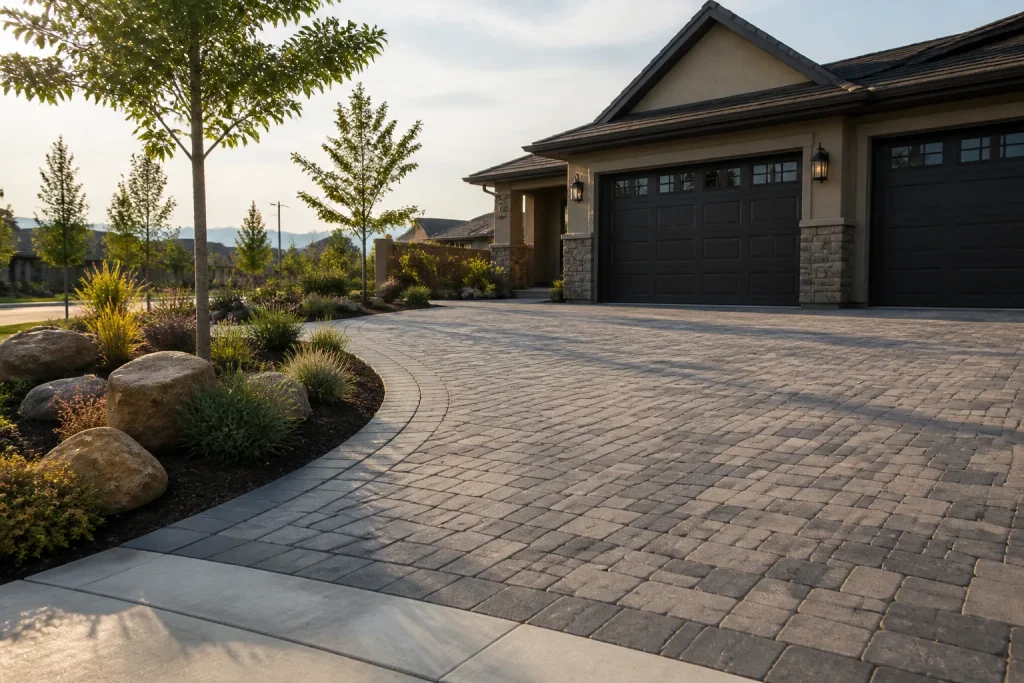
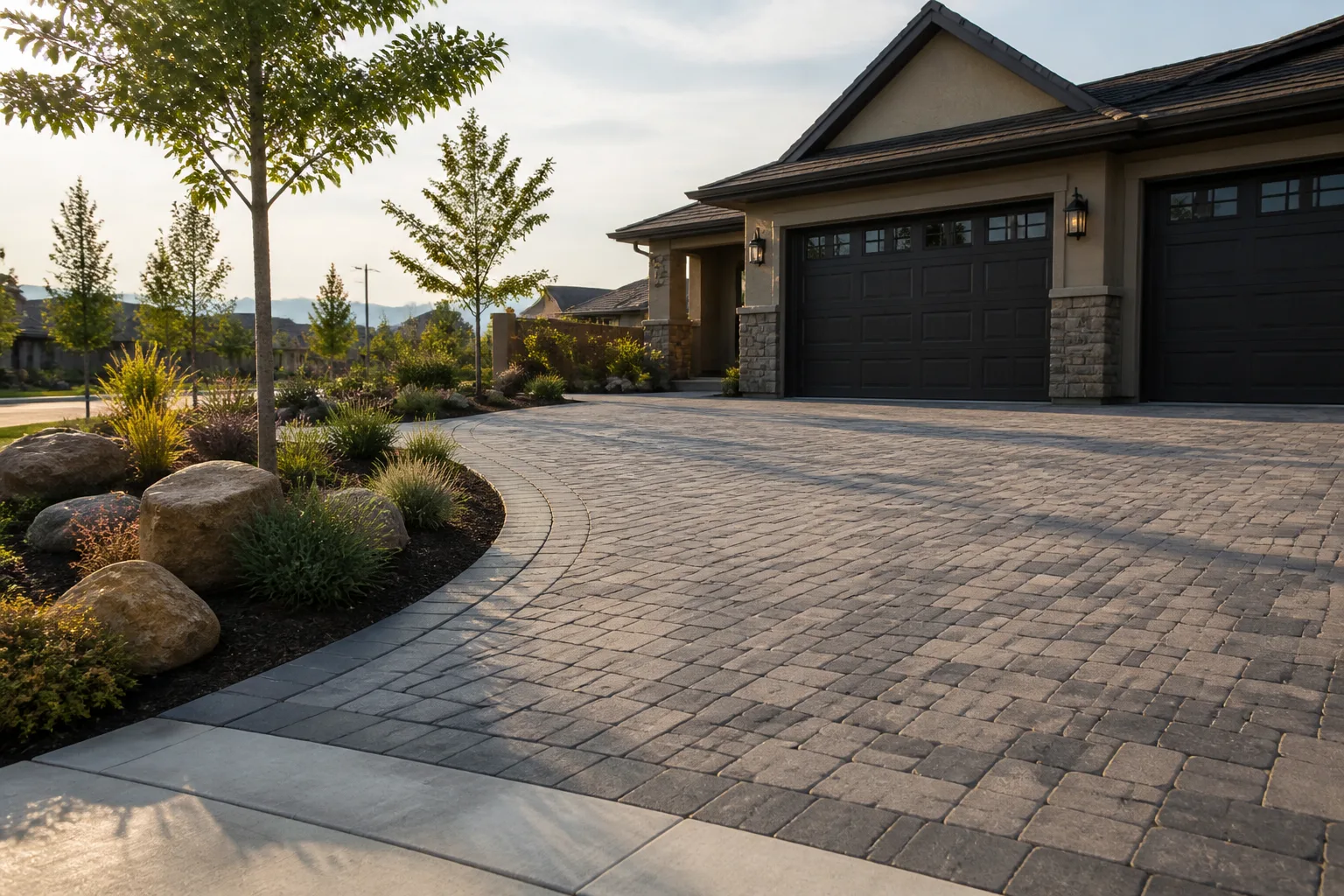
Schluter Driveway & Pavers in Lancaster: A Homeowner’s Guide
Schluter’s BEKOTEC-EN system cuts the mortar bed under driveway pavers from about 1.5 inches to roughly 0.75 inches, which sounds like free money until you learn it only works if the aggregate base beneath it is compacted to spec. In Lancaster’s silty desert soil, that means adding one compaction pass most contractors skip. Skip it and you’ve saved a few hundred dollars on base material while buying yourself a cracked field within two winters.
If you’d rather not spend your Saturday with a plate compactor, call (844) 797-3312 and we’ll put a written number in front of you before anything else happens.
What Is the Schluter BEKOTEC-EN System and Why Does It Matter for a Lancaster Driveway?
Schluter Systems is best known for edge trim and transition strips in tile work, but the company also makes a paver assembly system called BEKOTEC-EN. Instead of a thick bed of wet mortar under each paver, the system uses a thin panel layer that reduces the mortar requirement considerably. The pavers sit on a more controlled plane, the bed thickness drops, and the whole assembly gets less prone to the settlement cracks that show up in cheap sand-set jobs.
Here’s why Lancaster specifically cares. Lancaster sits on the Antelope Valley floor at roughly 2,300 feet, where summers routinely hit 105°F and winter nights dip into the 20s. There’s no meaningful freeze-thaw cycle to worry about, which is good. What you do get is aggressive thermal expansion and a soil profile that’s often silty and poorly graded. Pavers move. Bases that weren’t compacted properly settle. The BEKOTEC-EN system handles the first problem well. It does nothing for the second, which is why every installation we quote starts with compaction testing on the existing subgrade before a single paver is ordered.
Buyers in Quartz Hill and West Lancaster ask us constantly whether the Schluter system is worth the premium over a standard sand-set installation. Our answer: in a residential driveway subject to daily vehicle loads and 100-plus-degree summers, yes, provided the base is right.
DILEX-EKE vs. DILEX-AHKA: Which Schluter Edge Profiles Handle Vehicular Traffic?
This is where we see the most confusion on Lancaster job sites. Schluter makes dozens of edge profiles, and not all of them are rated for a car rolling over them. Getting this wrong means a profile that crushes under a tire within a season.
- DILEX-EKE is the profile family designed for vehicular traffic applications, with published load ratings that go up to roughly 3,000 pounds per wheel load depending on the specific variant and installation. This is the one for a driveway apron, garage approach, or anywhere a car actually drives.
- DILEX-AHKA is a movement joint profile intended for pedestrian and light-load applications. It’s excellent at the transition between a driveway, a walkway, and a patio slab, where the stress is foot traffic and slab movement, not tire loads.
- DILEX-KSN and DILEX-KSA are the pedestrian-grade movement joint profiles you’ll see on patios and pool decks. Not for driveways.
Where we’ve pulled bad installs in Palmdale and Lancaster both, it’s almost always a pedestrian profile used at a vehicle transition because the contractor grabbed what was on the shelf. Ask for the SKU on the quote. “Equivalent product” language in an estimate puts that risk on you.
How Much Thermal Movement Do Lancaster Pavers Actually Have?
A lot. That’s the honest answer, and it’s the number that surprises our clients most.
Using a typical concrete paver with a coefficient of thermal expansion around 0.0000055 per degree Fahrenheit, a 20-foot run in Lancaster experiences roughly 3/16 inch of expansion across a 70°F daily swing. A July day that starts at 68°F in the morning and peaks near 100°F by 3 p.m. is exactly that swing. Multiply by the width of the driveway and you’re looking at meaningful field movement over a full summer.
The Schluter system accommodates that with movement joints at regular intervals, typically every 12 to 20 feet depending on paver type and exposure. Those joints must be built into the plan, not added as a correction later. If your contractor’s written scope doesn’t name joint spacing, ask why. In our experience across Lancaster, most failures we see on driveways built before 2018 come back to movement joints that were spaced too far apart or omitted entirely at the perimeter.
What Does a Schluter System Driveway Cost Per Square Foot in Lancaster?
For a residential driveway in the Lancaster labor market, a Schluter mortar-free assembly runs $14 to $22 per square foot installed, assuming a properly prepped base. A conventional wet-mortar installation lands in the $11 to $17 range. That $3 to $5 per square foot premium covers the BEKOTEC-EN panels, the DILEX-EKE edge profiles, and the additional base prep the system demands.
Line-item, roughly:
- Excavation and grading: $1.50 – $2.50/sf
- Aggregate base with 4-inch compacted depth: $2.50 – $4.00/sf
- BEKOTEC-EN panel layer: $3.00 – $4.50/sf
- Pavers (Belgard, Techo-Bloc, or similar): $4.50 – $8.00/sf material
- DILEX-EKE edge profiles at vehicle transitions: $8 – $14 per linear foot
- Equipment, delivery, labor above: $2.50 – $3.50/sf
An “800 square foot driveway” quoted flat at $14,000 with no line items is a quote you can’t compare. Our quotes are flat prices with a written scope, so the number means something. See our Driveway & Pavers in Lancaster page if you want the full installation scope.
What Should the Signed Contract Specify About Schluter Components?
Every Schluter component on your driveway should appear on the signed scope by SKU. Not “Schluter or equivalent.” Not “paver edge profile.” By SKU, with the vehicular traffic rating stated for any profile installed where a car drives.
The practical risk you’re avoiding: an estimate that names “DILEX or equivalent” lets a contractor substitute a cheaper profile with a lower load rating, and you won’t know until the profile deforms under a tire. Under the discipline we work under, no change to the scope proceeds without a signed change order, which means the SKU on your contract at signing is the SKU installed. If a substitution comes up mid-project, it’s a written conversation, not a surprise.
The signed scope should also lock in base depth (4 inches compacted minimum, unless engineering says otherwise), compaction testing documentation, movement joint spacing, and the written warranty terms. That’s the whole point of a written price – the number and the specification live on the same piece of paper. You can review our Rowan Construction Group Lancaster home page for how the standard applies across all our trades.
When Should You Call a Pro?
If any of these apply, get a written scope on paper before you dig anything:
- The subgrade is silty or has visible soft spots
- The driveway ties into a garage slab or an existing apron
- You’ve had a prior paver job fail within two years
- Your slope pushes water toward the house or a neighboring parcel
These are the situations where compaction testing and proper DILEX-EKE placement stop being optional. We’ve seen the alternative play out in a driveway up in Lancaster near the Antelope Valley College – three years in, pavers heaving at the apron because the base was never compacted to spec and the wrong edge profile sat under the tire path. A pro-level installation removes that risk.
Related services in Lancaster: Fence Installation in Lancaster and Home Additions & ADU in Lancaster, both of which often share driveway and sitework scope with a paver project.
The Bottom Line
Schluter’s BEKOTEC-EN system is a good fit for a Lancaster driveway, provided two things happen: the base gets properly compacted to spec, and the edge profiles under vehicle traffic are DILEX-EKE, not a pedestrian profile that happens to be on the shelf. The premium runs $3 to $5 per square foot installed over conventional wet-mortar, and it buys you thinner mortar, tighter movement control, and better long-term performance under summer heat. What it doesn’t buy you is a substitute for compaction. Nothing does.
For a written price with the SKUs named before work starts, call Rowan Construction Group Lancaster at (844) 797-3312. Estimates are free, and we offer a free second opinion on any written estimate you’re already holding – review it line by line, no charge.
Frequently Asked Questions
Yes, for most Lancaster driveways subject to regular vehicle traffic. The $3 to $5 per square foot premium over conventional wet-mortar covers thinner mortar beds, better movement control, and a more predictable result in Lancaster’s 100-plus-degree summers. Call (844) 797-3312 for an exact quote on your square footage.
DILEX-EKE is the vehicular-traffic profile family, with load ratings up to roughly 3,000 pounds per wheel load depending on the variant. DILEX-AHKA, DILEX-KSN, and DILEX-KSA are pedestrian and light-load profiles. Check the SKU on your signed scope before work starts. Call (844) 797-3312 to review a competitor’s quote with us at no charge.
A Schluter mortar-free assembly runs $14 to $22 per square foot installed in the Lancaster labor market. A conventional wet-mortar installation runs $11 to $17. Line items for base prep, panels, pavers, edge profiles, and labor should all appear on the written quote. Call (844) 797-3312 for a flat written price before work starts.
Yes. A 70°F daily swing in Lancaster expands a 20-foot paver run by roughly 3/16 inch, and that movement must go somewhere. Schluter-rated movement joints spaced every 12 to 20 feet accommodate it. Missing or underspaced joints are the leading cause of paver failures we see in Lancaster. Call (844) 797-3312 for a written scope that names joint spacing.
Written by the team at Rowan Construction Group Lancaster.
Need Construction Help?
Call Rowan Construction Group Lancaster - licensed & insured, here with fast after-hours help in Lancaster.
(844) 797-3312