Last updated November 17, 2026
Free written scope consultation - allowances, timeline, and change-order rules on paper before a single trade is scheduled
How Long Does Driveway & Pavers Take? Timelines and What to Expect
A contractor says “3 – 5 days.” They mean installation days. They don’t mention the 2 – 3 weeks for permit approval, the 1 – 2 week material lead time, or the 72-hour polymeric sand cure window that means no vehicle use after the crew leaves. The job that starts March 1 is done in April. We’ve watched this gap between the quoted number and the real calendar confuse homeowners in Lancaster for years, so this guide lays out the full schedule: permit to cure, weather thresholds to contingency clauses, and the two dates you should get in writing before anyone breaks ground.
Quick Answer
A typical driveway paver project takes 4 – 8 weeks from signed contract to “ready for use,” not the 3 – 5 installation days most contractors quote. In Lancaster, permit approval alone runs 10 – 21 business days, material delivery adds 5 – 14 days depending on paver type, installation takes 3 – 5 working days for an average driveway, and the polymeric sand cure window adds another 2 – 5 days before you can park on it. Plan for the full calendar, not the crew’s days on site.
Styles & brands we work with
- Kitchen remodeling
- Bathroom remodeling
- Home additions & ADU
- Roofing
- Windows & doors
- Driveway & pavers
- Fence
Table of Contents
- Why the Real Schedule Is Longer Than the Quote
- Phase 1: Permit Application and Approval in Lancaster
- Phase 2: Material Order and Lead Times
- Phase 3: Site Prep, Base, and Paver Placement
- Phase 4: Cure, Sand Jointing, and Sealing
- What Weather Pauses a Paver Project in Lancaster
- Substantial Completion vs. Ready for Use
- Building Schedule Contingencies Into Your Contract
Why the Real Schedule Is Longer Than the Quote
When a contractor quotes “3 – 5 days” for a paver driveway, they’re quoting the days a crew is physically on your property. That’s an honest number for labor. It’s also the smallest piece of the calendar. The weeks before installation and the days after are where projects actually live or die on schedule, and they’re the part that rarely makes it into a verbal estimate.
Here’s the schedule a 500-square-foot driveway in Lancaster actually follows, in order:
- Contract signed and deposit paid
- Permit application submitted to the city
- Permit approved (10 – 21 business days)
- Paver and base material ordered and delivered (5 – 14 days)
- Site prep and excavation (1 – 2 days)
- Base installation and compaction (1 day)
- Paver placement and edge restraint (1 – 2 days)
- Polymeric sand jointing and cure (2 – 5 days)
- Sealing, if specified (adds 1 – 2 days and its own cure window)
That’s a 4 – 8 week range depending on how quickly permits clear and how long your chosen paver takes to arrive. Under The Haven Standard, Rowan puts this full schedule in writing before anyone touches a shovel. Clause 1 is simple: the price and the scope are written before work starts. The schedule belongs in the same document. If you want to see how this applies to the broader service, our Driveway & Pavers in Lancaster page walks through materials and pricing alongside it.
Phase 1: Permit Application and Approval in Lancaster
Permit approval is the single longest unglamorous stretch of a paver project, and it’s the one homeowners most often forget to budget time for. In Lancaster, plan on 10 – 21 business days from a complete submittal to an approved permit for a driveway replacement or new driveway.
What slows approval down:
- An incomplete submittal. Missing a site plan, a driveway apron detail, or a right-of-way dimension resets the clock. This is the most common cause of delay we see.
- Right-of-way or sidewalk work. If your driveway apron touches the public right-of-way, the review is more involved than a private-property paver install.
- Drainage review. Properties that slope toward a structure or a neighboring lot may need a grading plan showing where water goes.
- HOA approval, where it applies. Many Lancaster subdivisions require architectural review before the city will process the permit. That HOA step can run 2 – 4 weeks on its own and often happens in parallel, not in sequence, if you start it early.
The practical takeaway: ask your contractor who pulls the permit and who’s responsible for HOA approval. A contractor who submits a complete package the first time saves you a week or more. A contractor who tells you a paver driveway “doesn’t need a permit” is telling you something worth verifying with the city yourself.
Phase 2: Material Order and Lead Times
Once the permit clears, material lead time is the next real constraint. Not every paver is sitting in a yard waiting for you, and the brands worth using aren’t always the ones in stock.
Typical lead times we see:
- Stock colors and standard profiles: 5 – 7 days from order to delivery.
- Belgard and Techo-Bloc specialty lines: 7 – 14 days depending on the specific profile and color.
- Custom or non-stock colors: 3 – 4 weeks, sometimes longer, if the manufacturer is running production batches.
This is where sourcing depth matters. Rowan works across fifty-plus vetted brands, including Belgard and Techo-Bloc for pavers, so we can give you honest lead-time numbers for the product you actually want rather than steering you to whatever’s on hand. A written quote should name the paver brand, the profile, the color, and the quantity in square feet. Vague material descriptions are how lead-time surprises happen. If you’re also considering a property perimeter or privacy screen on the same timeline, Fence Installation in Lancaster can often run in parallel with the paver lead time to save calendar days.
Phase 3: Site Prep, Base, and Paver Placement
This is the part everyone pictures, and it’s the shortest part. For a 500-square-foot driveway, the on-site labor breaks down like this:
- Site prep and excavation (1 – 2 days). Removing the old surface, excavating to base depth, and grading for drainage. A driveway over an existing concrete slab takes longer than one over soil, because the slab has to come out.
- Base installation and compaction (1 day). The base is the layer under the pavers, typically crushed aggregate compacted in lifts. This is the layer that determines whether your driveway holds up for 20 years or starts settling in three. Compaction is done in measured passes, not eyeballed.
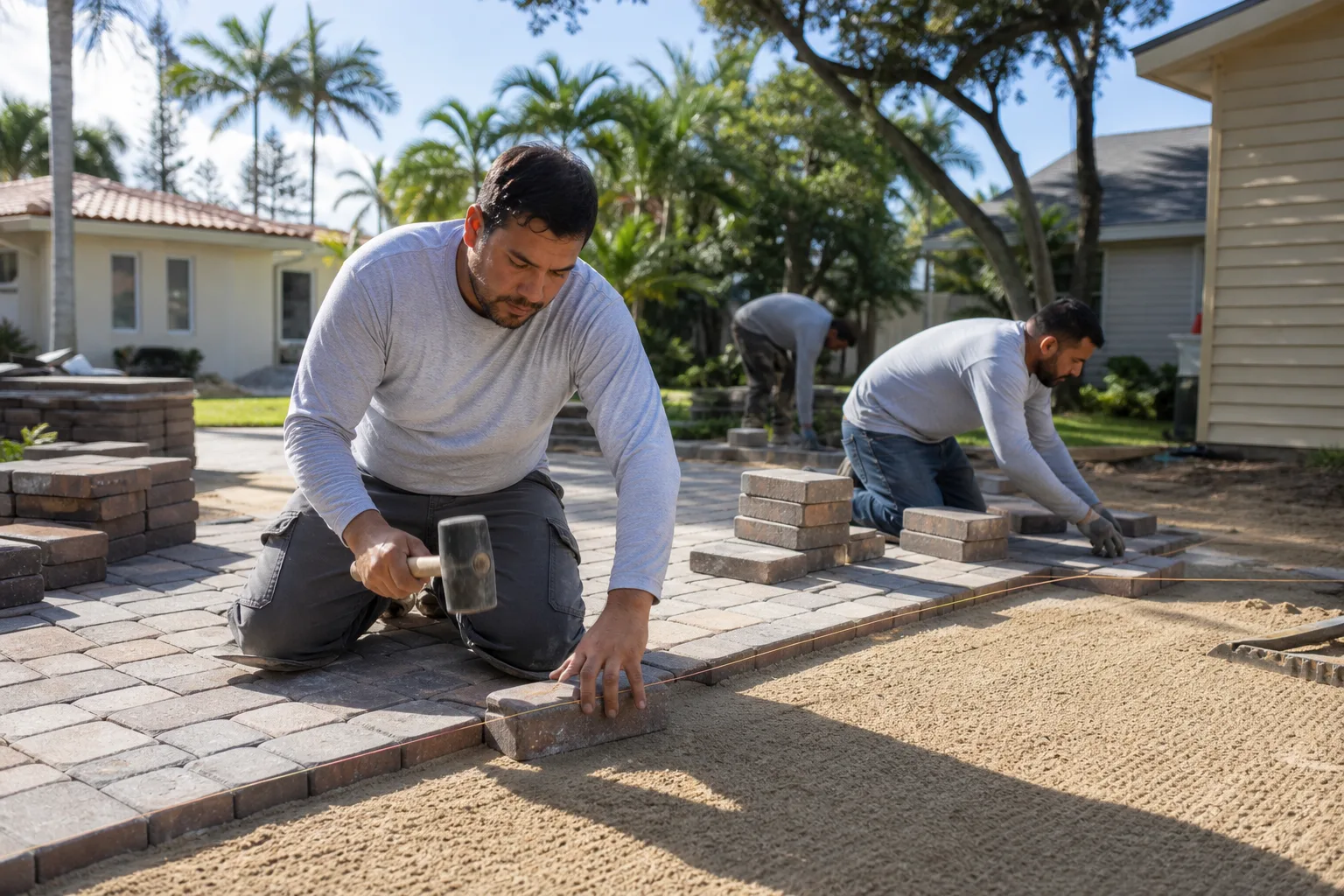
- Paver placement (1 – 2 days). Setting the pavers, cutting edge pieces, and installing edge restraint, which is the border that keeps the field from spreading.
Two days of prep, one day of base, one to two days of placement. That’s the 3 – 5 days you were quoted. It’s accurate for what it is. The problem is what it isn’t, which is the whole rest of the schedule. Understanding this difference is the point of this guide, and it’s why our Rowan Construction Group Lancaster home page leads with a written price and written scope on every trade, because the quote should show the full calendar, not just the busy days.
Phase 4: Cure, Sand Jointing, and Sealing
The crew leaves, and your driveway still isn’t ready for a car. This is the cure phase, and it’s the one most homeowners learn about too late.
Polymeric sand fills the joints between pavers and sets up to lock them in place. It needs time. The cure window is typically 72 hours before vehicle traffic and longer for heavy vehicles or hot-weather sealing schedules. Sealing, if you choose it, is a separate step with its own cure window, often 24 – 48 hours after application before foot traffic and longer before vehicles.
In practical terms for a Lancaster project:
- Polymeric sand jointing and initial cure: 72 hours minimum before vehicles. Longer in cool, humid weather.
- Sealer application: 1 – 2 days on site, plus 1 – 2 days cure before vehicle traffic.
- Total post-installation no-traffic window: 3 – 5 days as a realistic planning number.
So plan for your car to be parked on the street or in a neighbor’s garage for the better part of a week after the crew finishes. That’s not a delay; it’s the product curing as designed. Ask for the cure window in writing, because it varies by sealer and by sand.
What Weather Pauses a Paver Project in Lancaster
Lancaster weather is generally kind to paver work, but “generally” isn’t a schedule. There are specific thresholds that stop or pause a project, and knowing them helps you plan around them.
- Wind over 20 mph during sand jointing. Polymeric sand is swept into the joints and blown clean; wind above 20 mph makes a clean joint application difficult and can carry sand away from where it’s needed.
- Temperatures below 40°F during sealer application. Sealer doesn’t cure properly in cold weather and can cloud or fail to bond. If your project lands in a cold snap, sealer gets pushed to a warmer day.
- Standing water or saturated base. Base compaction requires a dry layer. If a rare storm saturates the excavated base, compaction waits until it dries, which can add 1 – 2 days.
- Extreme heat. Lancaster summers are hot. Concrete pavers can reach surface temperatures around 160°F in direct summer sun, which matters for sealer work and crew safety. August installations routinely add 1 – 2 days to the schedule because sealer application gets moved to cooler morning hours or cooler days. Labor on hot surfaces is also slower, and we build that into the written schedule rather than surprise you mid-project.
This is why a schedule that says “3 – 5 days” without a weather allowance is a schedule that will be wrong. Lancaster’s climate is manageable, but it isn’t invisible.
Substantial Completion vs. Ready for Use
Here’s the distinction that saves homeowners from a scheduling surprise: substantial completion and ready for use are two different dates, and you should ask for both in writing before you sign.
- Substantial completion: the date the pavers are placed, edge restraint is installed, and the crew is done on site. This is the date a contractor will usually quote.
- Ready for use: the date you can park a vehicle on the driveway. This is later, by the cure window, which is 2 – 5 days depending on sand and sealer.
Ask your contractor to put both dates in the contract. If they can only give you one, the one they give you should be the ready-for-use date, because that’s the date your car comes off the street. A written quote that states only the installation days is honestly stating the busiest days and leaving out the rest. Our policy under the Haven Standard is to state both, with the cure window defined, so the calendar matches what actually happens.
Building Schedule Contingencies Into Your Contract
Every construction contract needs a weather delay clause. The problem is that most of them say “weather delays” and stop there, which is a phrase, not a threshold. A defined threshold is what makes a clause enforceable and fair.
Here’s what a legitimate force majeure or weather clause should cover, and what it shouldn’t:
- Should cover: named, measurable events that make the work unsafe or impossible, including sustained winds over the threshold during sand jointing, temperatures below 40°F during sealer application, and saturated base conditions.
- Should cover: permit authority delays outside the contractor’s control, provided the contractor submitted a complete package.
- Should cover: material manufacturer delays outside the contractor’s control, provided the material was ordered promptly after permit approval.
- Should NOT cover: open-ended “weather” language with no threshold, which turns into a blank-check extension.
- Should NOT cover: delays caused by an incomplete or late submittal, or by ordering material after the permit cleared instead of in parallel.
Ask for the threshold in writing. A clause that reads “wind above 20 mph during jointing” is a defined condition. A clause that reads “adverse weather” is an extension of unknown length. Under Rowan’s process, no work proceeds on a change without a signed change order. That discipline applies to schedule changes too, not just scope changes.
Common Mistakes to Avoid
- Planning parking around the installation days. The car is off the driveway for the installation, plus the cure window. Plan for the ready-for-use date, not the substantial completion date, or you’ll be parking on the street longer than you expected.
- Starting the HOA approval late. In Lancaster subdivisions with architectural review, HOA sign-off can take 2 – 4 weeks. Start it as soon as you’ve chosen a paver profile, so it runs parallel to the city permit rather than after it.
- Quoting specialty pavers on a stock timeline. A custom color or profile can add 3 – 4 weeks to material lead time. If the calendar matters to you, choose a stock paver or order specialty early.
- Skipping the site plan on the permit submittal. The most common cause of a permit restart we see is an incomplete submittal. A complete package the first time saves a week or more.
- Accepting “weather delays” with no threshold. A clause with no defined threshold is an extension of unknown length. Ask for the numbers.
- Sealing in a cold snap. Sealer applied below 40°F can cloud or fail to bond. If your project lands in cold weather, sealing should wait for a warmer day rather than get forced.
- Not asking who pulls the permit. The permit is the longest part of the calendar. Know who’s responsible for it, and get a copy of the approved permit before work starts.
See the difference
 Before
 After
 Before
 After
 Before
 After
When to Call a Professional
Some paver work warrants a professional eye. If your driveway touches a public right-of-way, needs a permit, drains toward your foundation or a neighbor’s lot, sits over an old concrete slab that has to come out, or is part of a larger project like a home addition or ADU, get a professional involved before you commit to a schedule. A paver driveway that fails to drain or settles because the base wasn’t compacted in proper lifts is expensive to fix, and the base is invisible once the pavers go down. If your project overlaps with a home addition, Home Additions & ADU in Lancaster is a natural starting point for the larger scope, and our team coordinates the paver schedule around it. Rowan Construction Group Lancaster offers free estimates in Lancaster, with a written price and written scope before any work starts, and a free second opinion on any written estimate you already have. Call (844) 797-3312 to get the full calendar in writing.
Frequently Asked Questions
Installation itself takes 3 – 5 working days for a typical 500-square-foot driveway: 1 – 2 days site prep and excavation, 1 day base installation and compaction, and 1 – 2 days paver placement and edge restraint. The full project from signed contract to ready for use runs 4 – 8 weeks once you add permit approval, material lead time, and the cure window. Call (844) 797-3312 for an exact quote, and we’ll put both dates in writing.
Plan on 10 – 21 business days for permit approval in Lancaster, assuming a complete submittal. An incomplete package resets the clock, and HOA architectural review, where it applies, can add 2 – 4 weeks unless it runs in parallel. Ask who pulls the permit and get a copy of the approved permit before work starts. Call (844) 797-3312 to schedule your free estimate and we’ll walk through the permit timeline for your property.
No. The polymeric sand needs to cure, typically 72 hours before vehicle traffic and longer in cool, humid weather. If you’re also sealing, add 1 – 2 days of sealer cure. Plan for 3 – 5 days of no-traffic after installation, and ask for the ready-for-use date in writing. Call (844) 797-3312 to get that date on paper before you sign.
Wind over 20 mph during sand jointing pauses the work, temperatures below 40°F prevent proper sealer application, and a saturated base stops compaction until it dries. Lancaster summers also push concrete paver surface temperatures to around 160°F, which moves sealer work to cooler hours and adds 1 – 2 days to August schedules. Call (844) 797-3312 for a written schedule that accounts for these thresholds.
Under Clause 1 of The Haven Standard, the price is written before anyone starts, and no work proceeds on a change until the change order is signed. That’s the discipline that keeps projects within a few percent of the agreed cost. If a change is needed, you see the number and sign it before anyone proceeds. Call (844) 797-3312 for a flat written quote and a free second opinion on any estimate you already have.
A March start usually finishes in April, because permit approval (10 – 21 business days) and material lead time (5 – 14 days) push installation into the second half of the month, and the cure window pushes ready-for-use into the following week. A schedule that says “3 – 5 days” is quoting installation only. Call (844) 797-3312 to get the full calendar in writing before you commit.
The Bottom Line
The number that matters isn’t the 3 – 5 installation days your contractor quotes. It’s the 4 – 8 weeks from signed contract to ready for use. Permit approval in Lancaster runs 10 – 21 business days, material lead time adds 5 – 14 days, installation takes 3 – 5 days, and the cure window adds 3 – 5 more before you park a car on it. Ask for substantial completion and ready-for-use dates in writing. Ask for weather thresholds, not the word “weather.” And ask who pulls the permit. A written price and a written schedule, before anyone picks up a tool, is the only way the calendar matches what actually happens.
Rowan Construction Group Lancaster quotes every paver project with a flat written price and written scope before work begins, backed by the 365-Day Done Right Promise and a documented photo record on every visit. Our technicians have up to 19 years of experience, every crew member is background-checked and uniformed, and a live person answers calls 24/7. Call (844) 797-3312 for your free estimate in Lancaster, and we’ll put the full schedule in writing.
Written by the team at Rowan Construction Group Lancaster.